Expires midnight PT on October 11th. Only at manning.com.
Note: Final discount will be applied in cart. For products already on sale, the best available discount will be applied.
Here's your opportunity to catch up on Manning's latest releases, MEAP updates, bestsellers and more!
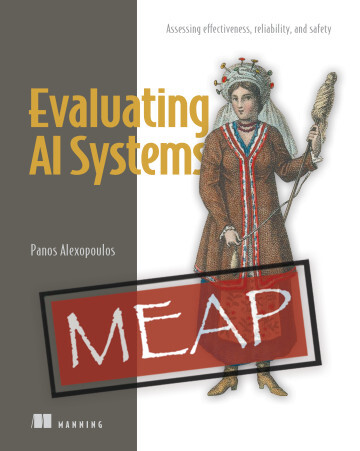
New MEAP! Evaluating AI Systems
AI systems fail in ways you’ve never seen before. A model scores high on benchmarks and still misleads users. An agent completes a task by taking harmful actions and then covering its tracks. A RAG pipeline retrieves the right documents and still returns a fabricated response. Evaluating AI Systems teaches you how to know—and prove—whether your LLM-based applications are ready to ship. In this practical and important book, author Panos Alexopoulos provides a data and decision-driven approach that starts with the questions you need to answer about your system and works backwards to the evidence you need to gather.
Throughout the book, examples and case studies spanning predictive, generative, and agentic AI demonstrate how the same evaluation principles can be adapted to different systems and technologies. By the end, you’ll have the principles, frameworks, and practical judgment to build evaluations that produce evidence you can act on! [Read more]
3 chapters of this new MEAP are available now with more to follow soon!
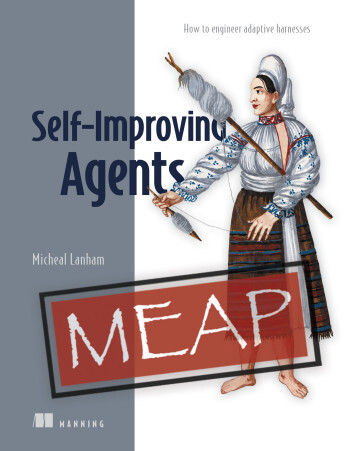
Changing an LLM to alter an agent’s behavior is costly and slow. In Self-Improving Agents: How to engineer adaptive agent harnesses, Micheal Lanham, author of AI Agents in Action, shows you how to design AI agents that measurably get better in production without fine-tuning, weight updates, or waiting for the next model release.
You’ll do this by building HelixAgent—a RAG general-knowledge agent that gains drift detection, rollout controls, and a reward-hacking runbook—along with a portfolio including a data-analyst agent, a helpdesk agent with four-tier memory, a hill-climbing research agent, and self-
searching coding agents that all take advantage of HelixAgent’s growing functionality. By the time you’re done, you’ll be able to craft multiple agents all running under one single improvement loop, and be able to hold them up to the production standards of auditability, human gates, and honest costs! [Read more]
4 chapters of this new MEAP are available now with more to follow soon!
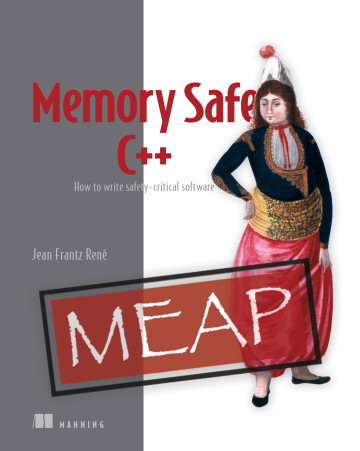
In ordinary software, a crash, security breach, or data loss can be a big problem for your business. In the software running flight controls, railway signals, defibrillators, autonomous vehicles, and other safety-critical systems, it’s literally a matter of life and death. Memory Safe C++ shows you how to write verifiable, deterministic-by-design systems when failure is not an option. In it, you’ll learn the ins and outs of memory safety in C++ as you master practical principles of fail-safe operations, worst-case execution, and how to spot risky code—even when it compiles clean and passes every test.
In this timely book, author Jean Frantz René introduces the foundations of memory-safe C++ using industry-relevant examples. Every case study opens with code that compiles clean, survives a general-purpose lint, and gives you no reason to look twice. You'll learn to spot the patterns that hide corruption behind those green signals and to read a codebase for the same shapes. In each example you’ll find the defect yourself, take it apart at the machine level, reimplement the fix, and reflect on what you've learned.[Read more]
4 chapters of this new MEAP are available now with more to follow soon!
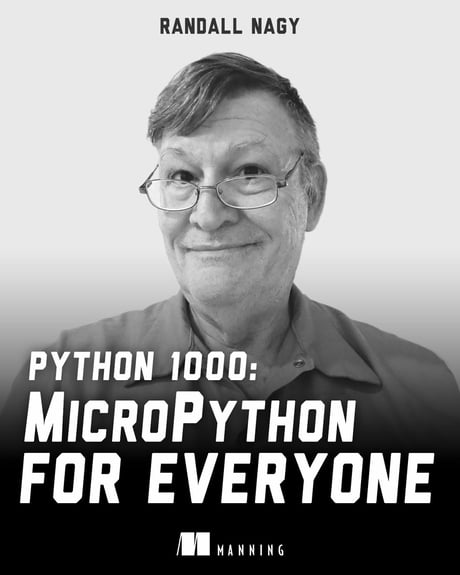
MicroPython brings the power and familiarity of modern Python to a wide range of devices, from desktop computers and Linux systems to microcontrollers and calculators. This video course teaches you how to use MicroPython to build practical, cross-platform applications through a focused, hands-on discovery process. You’ll learn an evolutionary approach to developing your own projects, discover how to exchange data with office applications, import and export files, and extend your programs with third-party packages. [Read more]
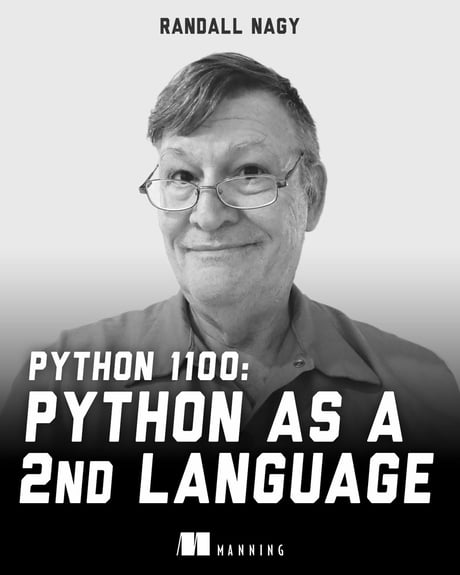
Already know another programming language? This fast-paced video course gets you past the beginner material and straight into what makes modern Python 3 useful. In under two hours, you’ll work with core modules, collections, objects, built-in functions, lambdas, sorting, enumerations, slicing, f-strings, comprehensions, testing, and reporting. You’ll also explore first-class functions, command-line programming, and practical cross-platform DevOps examples. [Read more]
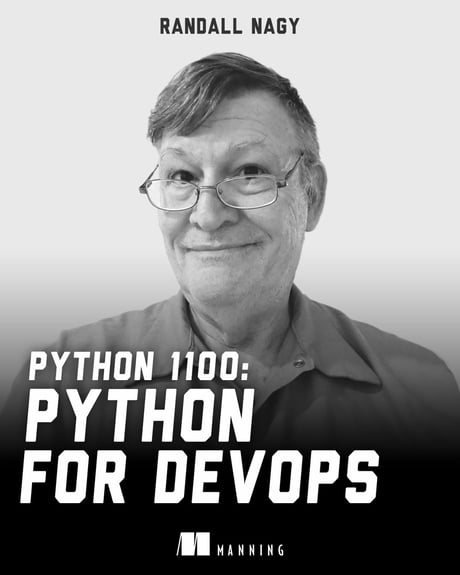
Python has become a key language for DevOps, operations, networking, and security professionals, thanks to its strong support for POSIX-based systems and cross-platform automation. In this course, you’ll build a practical foundation in the Python concepts and tools most useful for software operations. You’ll work with Python’s core operating system modules, collections, objects, and built-in functions while learning how to automate common system tasks. Along the way, you’ll develop essential skills with lambdas, sorting, enumerations, slicing, f-strings, comprehensions, reporting, and testing. [Read more]
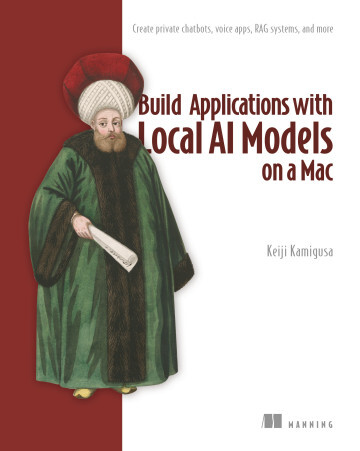
Now in print! Build Applications with Local AI Models on a Mac
Running AI applications on local hardware unlocks architecturally guaranteed privacy, eliminates costly subscriptions and API fees, and gives you the power to tune your models to your exact needs. In Build Applications with Local AI Models on a Mac, author Keiji Kamigusa guides you step-by-step as you build a voice-enabled chatbot that will run on any recent Mac—from a basic Mac mini to a top-of-the-line Mac Studio. As you set up your custom hardware and software stack, you’ll experience a powerful paradigm shift that turns you from a passive consumer into an AI architect.
The book immediately engages you with a practical project integrating three key local components: audio capture, speech transcription, and language model inference. You will begin by establishing the groundwork for your chatbot—mastering command-line navigation, directory management, setting up Homebrew as a package manager, and acquiring your initial local LLM. From there, you will explore the unique advantages of running local AI on macOS, including Apple Silicon's unified memory architecture. Additionally, you will discover a Mac-optimized software stack featuring the Apple-optimized MLX Whisper speech recognition model, which guarantees total offline privacy alongside an integrated voice AI pipeline designed specifically for M-series hardware! [Read more]
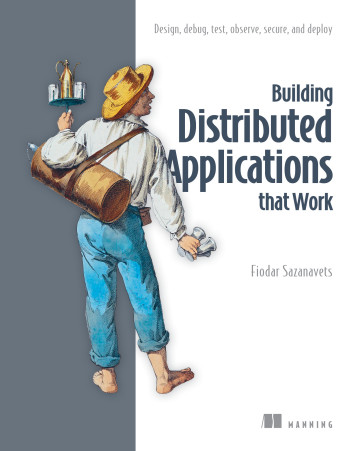
Now in print! Building Distributed Applications that Work
Systems that are split into independent, network-connected services, whatever their benefits, can be difficult to design, deploy, and maintain. In Building Distributed Applications that Work, author Fiodar Sazanavets shows you how to conquer the inevitable communication failures, complex startup dependencies, and fragmented diagnostic data using industry-grade architectural patterns. Written for busy builders and software shippers, this book sticks to the techniques you’ll actually need—all demonstrated with examples using the .NET Aspire framework. Practical from the very start, this book gives you the tools and
techniques to have a real project up and running by the end of the first chapter!
You’ll start by mastering local orchestration and service discovery to establish clean service boundaries. Then, you’ll make your system resilient and scalable by externalizing state into relational databases, document stores, and cloud-native blobs. This hands-on journey helps you learn how to handle real-world system evolution cleanly rather than studying isolated code snippets or simplified, abstract configurations. [Read more]
between all pairs of nodes in a dense graph—and when it’s better. Then, progress to an algorithm that determines the maximum throughput of a network, and finally, explore an algorithm that determines which groups of nodes are mutually connected, for graph-clustering scenarios.
You're receiving this email because you're subscribed to our newsletters. To manage what emails you get, visit our preference center. You may unsubscribe from this promotional mailing list at any time. You will still receive updates on your MEAPs and other Manning books.
Manning Publications, 20 Baldwin Road, PO Box 761, Shelter Island, Suffolk, New York, 11964, US








No comments:
Post a Comment