Sponsored
⚠ ROUND CLOSING SOON · $0.79/SHARE · $IMRS NASDAQ RESERVED ⚠
4,000% growth.
Round is closing.
Most companies pitch growth. Immersed already has it. 4,000% in valuation, 8,000+ investors, NASDAQ ticker reserved.
They built the #1 productivity app in AR/VR. 1.5M users. Power users work up to 60 hours a week in it.
Then they built the hardware. Visor: lighter, sharper, significantly more affordable. 75,000+ on the waitlist before shipping.
Now they’re adding AI. Curator, your meeting-summarizing, day-organizing AI assistant. Already in early access beta.
Three verticals. One platform. Still private.
4,000%
Valuation Growth |
1.5M
Active Users |
$35M+
Raised to Date |
$71M
Projected Revenue |
✓ #1 productivity app on Meta Quest: 4.3 stars, 78% five-star reviews
✓ Visor headset: 75,000+ waitlist before first shipment
✓ Curator AI: in early access beta
✓ Partners: Intel + Samsung
✓ $IMRS NASDAQ ticker reserved
REG A+ · OPEN TO ALL INVESTORS · CLOSING SOON
Entry price: $0.79/share Up to 20% bonus shares. 9,500+ investors already in.
P.S. The previous Intel CEO, SailPoint’s Mark McClain, and Tim Tebow all invested. You’re still early.
Disclaimer: Immersed is offering securities through the use of an Offering Statement that has been qualified by the Securities and Exchange Commission under Tier II of Regulation A. The valuation is set by the Company and there is currently no public market for the Company’s Common Stock. Please read the offering circular and related risks at invest.immersed.com. Nasdaq ticker “IMRS” has been reserved by Immersed and any potential listing is subject to future regulatory approval and market conditions.
⏱ The Quick Read
• When a giant finally goes public, the crowd buys the ticker everyone already knows. History says that’s rarely where the best return sits.
• One company already shows 4,000% valuation growth and $71M projected revenue — while still private.
• When Facebook went public, one overlooked stock rose 611% while Facebook itself rose 269%.
• One thread: the giant is the headline, not the trade. See the company already proving it out (AD)
When a Giant Goes Public, the Best Trade Is Rarely the Giant ItselfEvery trillion-dollar IPO creates the same optical illusion: it makes the headline company look like the opportunity, when historically it’s often the opposite. The giant’s valuation is set by the time regular investors can buy in, priced by bankers, and immediately traded by a crowd that already knows the story. The real asymmetry tends to sit one layer away — in the companies still building quietly while the spotlight is pointed elsewhere. This isn’t a knock on the giant itself. SpaceX, OpenAI, Anthropic — these are real companies solving real problems at enormous scale, and their IPOs are legitimately historic events. The point is narrower and more mechanical: the size of the headline and the size of the remaining opportunity are two different things, and conflating them is what sends most of the crowd’s money to the most expensive, most efficiently priced asset in the entire ecosystem the IPO touches. That’s the case for getting exposure before a company needs a headline IPO at all. A business that can already show real growth, real revenue, and real user numbers while still private isn’t betting on a story that might play out — it’s pricing in results that have already happened, at a stage most investors never get access to. Think about why that matters mechanically. Once a company lists, its price reflects every piece of public information plus the enthusiasm of everyone who wanted in on day one. Getting there earlier — while the growth is real but the audience is still small — is the only way to buy the story before its price catches up to the facts. That gap between demonstrated results and public awareness is where the asymmetry actually lives, and it closes permanently the moment the company rings the opening bell. 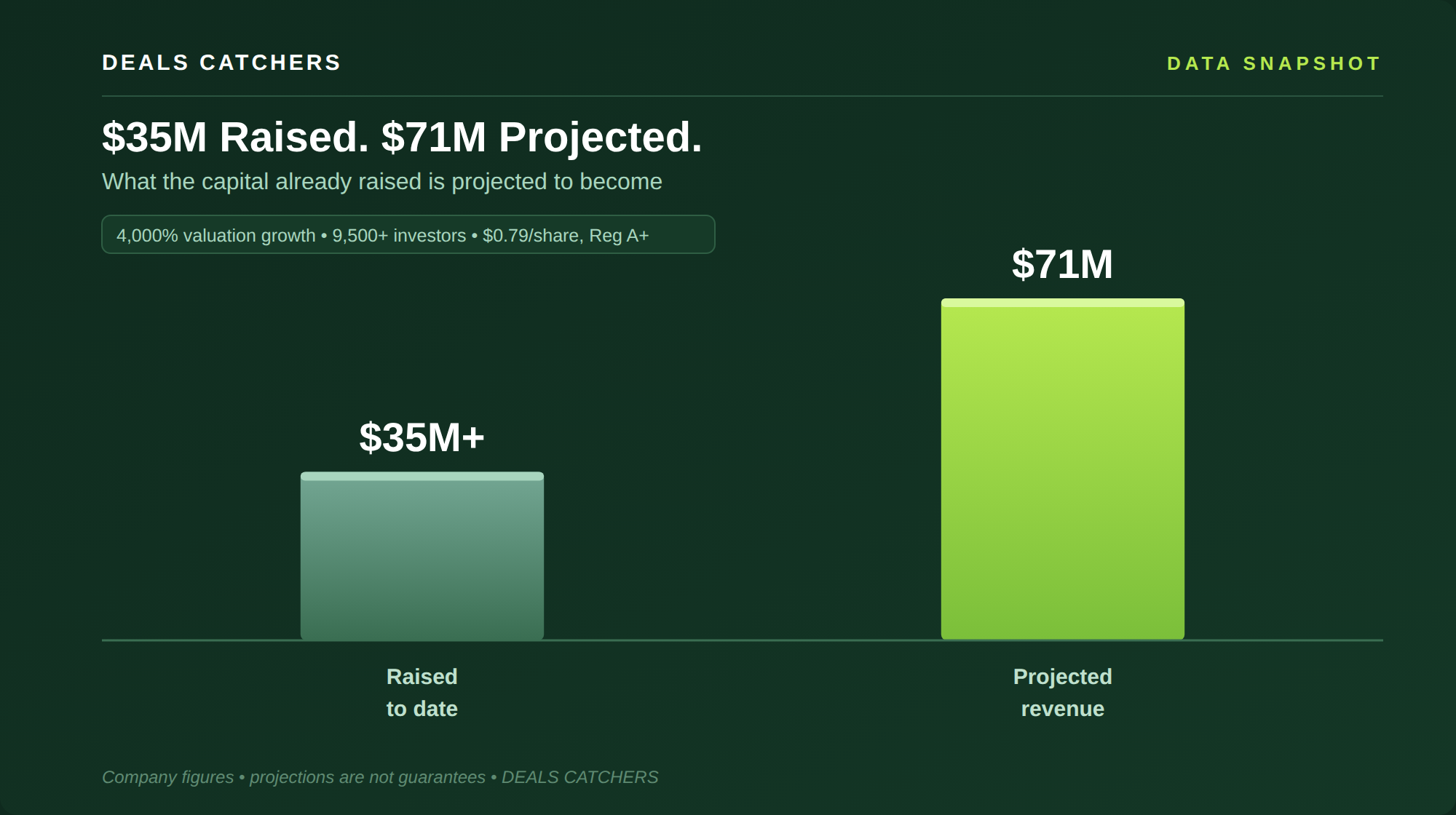 The chart shows exactly that kind of forward math: capital already raised against what the company projects that capital becomes. Whether or not the projection lands precisely, the structural point holds — this is a company being valued on demonstrated traction, not just a narrative, and the promo above lays out the entry price and the numbers behind it while the round is still open. The Data Behind the BackdoorIf you want to see “the giant isn’t the trade” proven with numbers instead of theory, the pattern has repeated across nearly every major IPO of the last decade. The company going public gets the headline and the valuation everyone already knows; a smaller, associated business sitting in its orbit gets bought by almost nobody — right up until it quietly outperforms the star of the show. 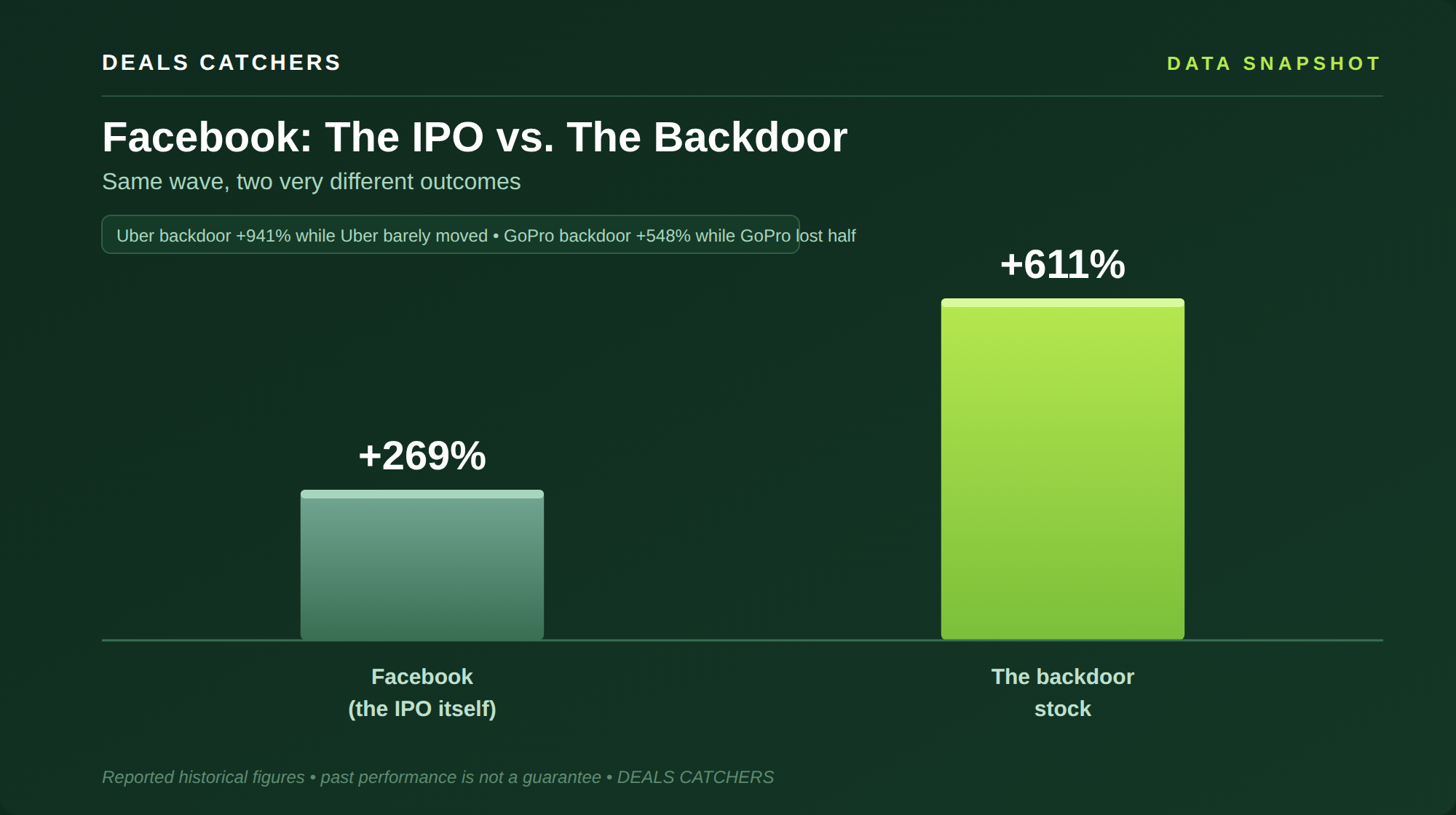 The chart makes it concrete: Facebook’s own IPO returned a real but unremarkable gain, while a lesser-known stock connected to the same wave more than doubled that return. The badge adds two more data points — Uber and GoPro — where the pattern repeated with even starker gaps. None of this guarantees the next repeat performs the same way, but the mechanism is consistent enough that it has a name. The promo below is one attempt to identify where that mechanism might be forming again, around the two AI companies currently racing toward the biggest IPOs in history. Why does this keep happening? Because an IPO doesn’t just create one investable asset — it validates an entire business relationship. Suppliers, partners, and adjacent companies that were quietly benefiting from the giant’s growth suddenly get re-rated by a market that finally notices them, often well after the headline company’s own valuation has been fully priced in by the underwriters. The IPO is the moment of recognition. The backdoor stock is where the recognition hasn’t landed yet.
Sponsored 
A huge number of people will get rich from the OpenAI and Anthropic IPOs. But you probably won’t be one of them. Even if you get in at 9:31 am — one minute after the markets open — on IPO day.
This is why Luke Lango went to Idealab — the venture capital machine behind seven billion-dollar companies. By the time a company goes public, the insiders have already taken the lion’s share.
Peter Thiel got into Facebook before it went public. His stake went up as high as 200,000%. People who bought Facebook on IPO day watched it drop 50% in four months. Same company. Completely different outcomes. The only difference was timing. That’s how it has always worked. Until now.
There is a publicly traded ticker that gives everyday folks a “backdoor” way in both OpenAI and Anthropic — right now, while both companies are still private. No accreditation. No minimum net worth. Starting with as little as $200. That ticker is AGIX.
But Luke says AGIX is just the beginning. Because the biggest potential gains from a massive IPO rarely come from owning the IPO stock itself. They come from the companies surrounding it. Luke calls it the “Pre-IPO Backdoor.”
When Facebook went public, one backdoor stock went up 611% while Facebook itself went up 269%. Goldman Sachs got into Facebook early and made 575%. A regular investor who found the right ‘backdoor’ stock made more than Goldman Sachs.
When Uber went public, one backdoor stock went up as high as 941% while Uber barely moved. When GoPro went public, one backdoor stock went up as high as 548% while GoPro investors lost more than half their money.
OpenAI is targeting the first trillion-dollar IPO in history. Anthropic is right behind it at $900 billion. Both going public in the same industry at the same time. Luke says this is the largest backdoor opportunity he has seen in his career.
He has put his No. 1 play — plus three additional positions across the AI supply chain — inside a special report called The Pre-IPO Backdoor. The ‘backdoor’ only works while these companies are still private.
The Wave the Giant IPO CreatedThere’s a third way the crowd misses the real trade: by watching the company that went public instead of what its success just made possible. A landmark IPO doesn’t just move one stock — it can validate an entire technology and open markets that didn’t exist the week before. The company that benefits most from that shift is often not the headline name, but whichever business was already positioned to serve the audience the headline just created. That’s the logic behind a satellite-connectivity story that has nothing to do with rockets. When phones in previously unreachable regions suddenly come online, the immediate winners aren’t the network operators — they’re the platforms already built to serve a newly connected population with apps, content, and ways to earn. The promo below argues Mode Mobile is positioned for exactly that shift, with growth and profitability figures already in hand before its own IPO. This is the same discipline as the first two sections, just applied one step further downstream. It’s not enough to ask what a giant IPO is worth, or which smaller stock rode its coattails last time — it’s worth asking what entirely new market the underlying technology just unlocked, and who was already standing in that market before anyone else noticed it existed.
Sponsored 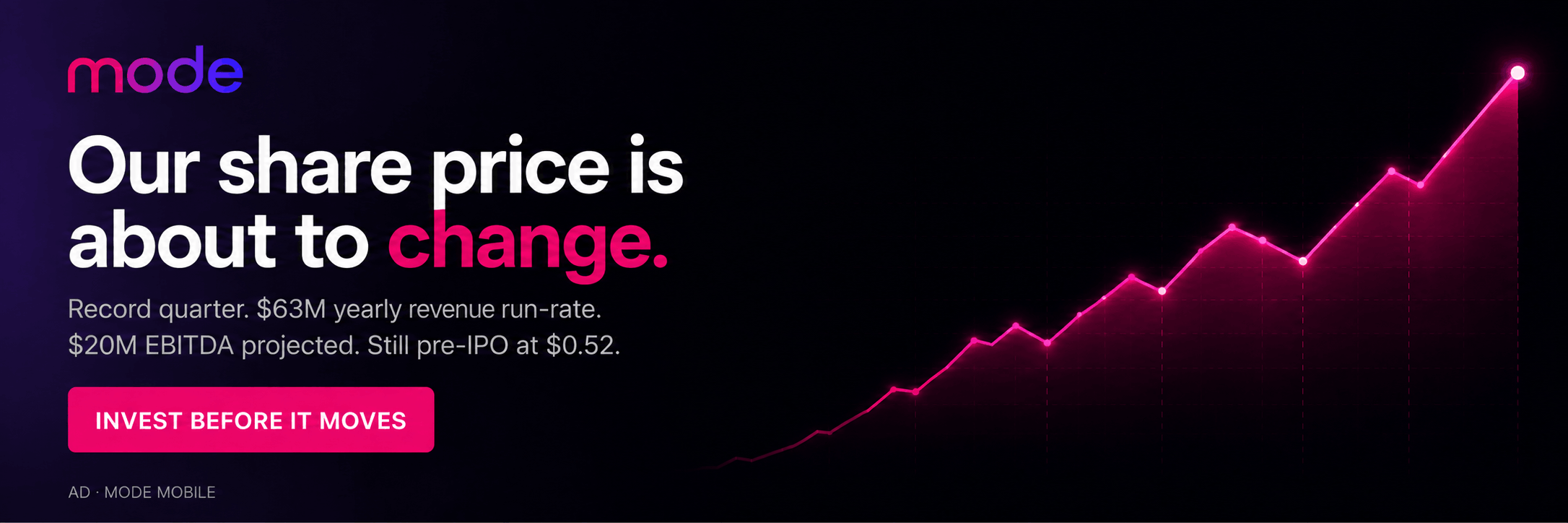
SpaceX went public at a $1.77 trillion valuation. Could be the largest in history. But the most interesting play right now isn’t SpaceX. It’s what Starlink just made possible.
Apple enabled satellite connectivity on iPhones last month. Billions of people in dead zones — rural areas, developing markets, places ground networks never reached — just came online. Instantly. Every one of them has a smartphone. Every one of those smartphones needs apps, content, ways to earn.
That’s the market Mode Mobile has been quietly building for. Before going public, their numbers already look like this:
- 490M+ users globally
- $11.8M EBITDA in 2025 — profitable, before IPO
- 32,481% revenue growth over 3 years
- Deloitte’s #1 fastest-growing software company in North America
- $MODE ticker already reserved on Nasdaq
Two rounds sold out. 59,000+ investors committed. Still open at $0.52 — until soon.
Please read the offering circular and related risks at invest.modemobile.com. This is a paid advertisement for Mode Mobile’s Regulation A+ Offering. Mode Mobile recently received their ticker reservation with Nasdaq ($MODE), indicating an intent to IPO in the next 24 months. An intent to IPO is no guarantee that an actual IPO will occur. The Deloitte rankings are based on submitted applications and public company database research, with winners selected based on their fiscal-year revenue growth percentage over a three-year period. Pro forma revenue and EBITDA, includes full year numbers of the businesses acquired throughout 2025.
Why the Crowd Keeps Buying the Headline AnywayIf the data is this consistent, why does the crowd keep piling into the obvious ticker on IPO day? Because the headline company is easy. It has a name everyone recognizes, a valuation everyone’s already discussed, and the comfort of buying something familiar. The backdoor stock, the still-private company, the infrastructure play riding someone else’s wave — all of these require research, patience, and the discomfort of explaining a position nobody else has heard of. There’s a timing element too. The giant’s IPO is a single, scheduled event with a date on the calendar — easy to plan around, easy to act on when everyone else is acting. The overlooked opportunities in its orbit rarely announce themselves with a date. They have to be found, which means doing the unglamorous work of asking who benefits before the benefit is obvious to anyone reading the headlines. There’s also a comfort mismatch working against the smarter trade. Buying the giant on IPO day feels validated — you’re doing what the news, the analysts, and everyone around you is doing. Buying the quiet company still building, or the associated stock nobody’s discussing, or the platform positioned for a market that barely exists yet, feels exposed by comparison. That discomfort isn’t a signal to stop; historically, it has been closer to the price of admission. So the discipline is to treat every giant IPO as a prompt rather than a destination: not “should I buy this,” but “what does this event make possible, and who’s already positioned for it.” That question, asked consistently, is what turns a headline everyone reads into an edge almost nobody acts on. One Thread: The Giant Is the Headline, Not the TradePull them together and the pattern is identical. A private company proving its growth before it ever needs a headline IPO. A backdoor stock that has historically outrun the star of the IPO it rode in on. An infrastructure play positioned for the market a giant’s success just opened up. Three different mechanisms, one discipline: when the crowd is fixated on the giant, look at what surrounds it.
The Through-Line
The headline is priced already. By IPO day, the giant’s valuation reflects everyone who already knows the story.
The orbit often outperforms the star. History shows backdoor stocks beating the IPO they surrounded, repeatedly.
Success creates new markets. The biggest winner from a landmark IPO is often whoever was already positioned for what it enabled. |
The Watchlist
| Ticker |
The trend right now |
| SPCX |
The headline IPO at a reported $1.77T valuation — the giant everyone’s watching. |
| META |
The textbook case — its own IPO gain was outrun by a backdoor stock nobody was watching. |
| UBER |
Barely moved on its own IPO while a backdoor stock in its orbit reportedly ran 941%. |
| ASTS |
Satellite-to-phone connectivity — the same wave Starlink and Apple just opened up. |
The Bottom LineA trillion-dollar IPO is designed to be the story everyone tells. But the data on what actually pays best around those moments is remarkably consistent: the giant getting the headline is rarely the best-performing asset connected to the event. The real return tends to sit with whoever was positioned early, quietly, before the story became obvious to everyone else. We’ve held one thesis through every version of this. The opportunity isn’t the ticker making headlines — it’s the company already proving its numbers while still private, the overlooked stock riding the same wave, the business positioned for what the giant’s success just made possible. Each is a reminder that proximity to a giant IPO is not the same thing as being invested in the giant. None of this is a guarantee, and none of the historical comparisons in this issue promise the next repeat behaves the same way. But the pattern has shown up often enough, across enough unrelated companies and sectors, that it’s worth treating as a standing question rather than a one-time observation — something to ask every time a giant IPO dominates the news cycle, not just this one. So the question for your accounts isn’t “should I buy the IPO everyone’s talking about.” It’s “what does this IPO make possible, and who was already positioned for it before the headline hit.” The repositioning that matters is happening quietly, done by people looking past the giant to what surrounds it. Forget the hot picks — protect what you’ve already built, and look past the giant to what surrounds it instead of chasing the headline. Because the best trade you’ll ever make is the loss you never took. — Lee
|

No comments:
Post a Comment