We were old friends—Paul, Terry, and I—and by old I mean more than 40 years since we'd worked together on a Northern California beach for the National Park Service. They stayed in the US. I left more than 20 years ago to teach English overseas and eventually settled in Portugal, helped along by the country's bargain property values.
It had been ages since I'd seen either of them, and even longer since we'd all been together. Paul proposed a reunion on the Douro and booked a private three-day trip with Sailo for $3,615 all in.
Whatever past each of us carried could stay on the dock that morning. For now, the chance to ride together again beckoned—albeit with arthritic knees and reading glasses this time around.
Our home for three days and two nights was a 42-foot cabin cruiser captained by Tiago, who'd been skippering on the Douro since he was 17.
With him was Daniel—deckhand, chef, and helmsman-in-training. We'd travel upriver to Pinhão in the heart of the Douro's wine country, spend one night in Peso da Régua, another in Pinhão, then turn back.
The boat was simple and comfortable: space to lounge, berths below, a compact kitchen, and a shower. In the late-September heat, we settled into river rhythm—cool drinks, light snacks, and long conversation as the landscape slid past.
Before long we reached the first dam and waited to enter the lock. Later came the second, and the slow, mechanical lift that carried us onward.
Between locks we stopped for coffee at a quinta. Paul wandered, as he tends to do, returning with photos from a cemetery he'd discovered. "Every single grave had fresh flowers," he said—another reminder of how the Portuguese honor everyday life and the people who came before.
Back on the water, we passed a towering golden angel on the south bank where two bridges cross side by side. The monument honors victims of the Hintze Ribeiro Bridge, which collapsed in March 2001 during severe flooding.
Locals avoided the replacement bridge for years, calling it cursed, so a second bridge was built only feet away.
With the heat in full swing, we stopped for a swim before the next lock. A massive "hotel boat" slid by—proof that this river is both working waterway and vacation dream. Not long after, a Roman-built bridge appeared, still connecting two hillsides after centuries.
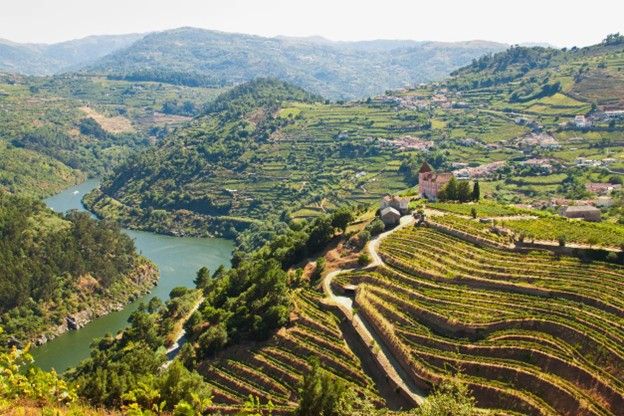
By evening we reached Peso da Régua—Régua to locals—where terraced vineyards climb the hillsides. After sunset the town felt strangely quiet, and we wandered dark streets looking for somewhere open.
"Does anyone actually live here?" Terry joked.
Eventually we found a modest restaurant and ate well—local dishes, good wine, and the easy laughter that comes when the years between you start to dissolve. We walked back to the boat under a mild night sky, and I slept on the stern deck, lulled by river air and stars.
The next morning Régua looked like a different place: shops open, streets busy, people heading to work. Before departing, we stopped at the Douro Museum, devoted to preserving the region's heritage.
Soon we were back upriver under another clear sky, passing our last lock. While we waited for the green light, gunfire echoed from the hills.
"Wild boar hunters," Tiago said.
Not long after we reached Pinhão, the heart of Douro Valley wine country. We booked a tasting at Real Companhia Velha, founded in 1756 and still Portuguese-run. From a ridge lined with vines, we looked down at the Douro snaking through the valley. We tasted grapes straight off the vine, then sampled Ruby and Tawny ports.
I raised my glass. "Here's to the different paths we took that have once again converged in this beautiful place, in this beautiful now."
That night we ate at a small restaurant beside an old bridge and ordered port—then another. The food was excellent, but what I remember most is the simple luxury of being together again.
When we reached the marina the next day, we thanked Tiago and Daniel and said our goodbyes.
The trip began as a reunion, but in the company of old friends the ancient Douro became personal—history absorbed not just as scenery, but as something shared.
Three days on the river gave us memories to carry forward, before that vast open sea of unknown waters comes into view again.





No comments:
Post a Comment